Stem-cell teams already want foundation models in the imaging loop. The blocker is rarely the science — it is the hardware next to the incubator. A ~305M-parameter segmentation model does not fit comfortably on the CPUs and edge systems that sit beside culture workflows, and “just compress it” is not a release plan when a bad mask can delay passaging or distort a confluence call.
Capicú’s latest paper, peer-reviewed and accepted at the NeurIPS 2026 LatinX in AI (LXAI) Workshop, turns that operational problem into a product-grade answer: compress for the bench, then prove — modality by modality — that the model still behaves like the full-precision reference.
Read it on arXiv or Hugging Face Papers.
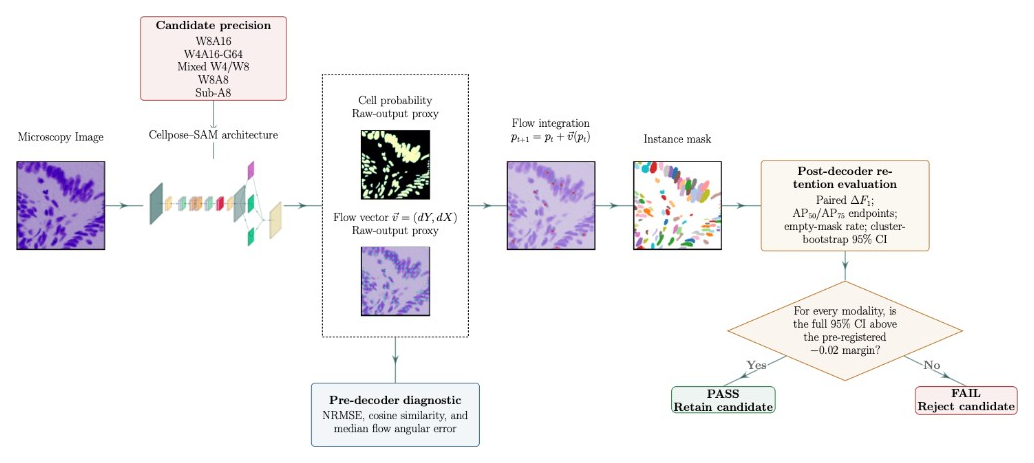
Capicú’s retention protocol: candidates are compressed, decoded into instance masks, and accepted only when paired performance stays within a pre-specified margin on every imaging modality — with bootstrap confidence intervals and released audit artifacts.
The innovation clients actually need
Most compression work optimizes a single score. We built something different: a retention protocol that answers the question a manufacturing or process-development team asks before putting a model next to an instrument.
- Fix the acceptance margin before looking at hold-out data.
- Judge the decoded mask, not a tensor that can look healthy while instances disappear.
- Require the scheme to pass on every imaging modality in the panel — not an average that hides a failing regime.
- Publish artifacts so an independent reviewer can re-derive the verdict.
That is the difference between a research compression recipe and a deployment decision your quality, validation, and operations partners can stand behind.
What we showed
On a stratified 176-field panel spanning BBBC038, BBBC039, and NIST iPSC culture-density regimes:
- Weight-only W8A16 keeps instance quality tightly aligned with FP32 across modalities.
- A sensitivity-guided mixed W4/W8 scheme reaches 6.76× smaller weight storage with no catastrophic failures observed (0/176 fields) at this sample size.
- Ternary compression hits 12.08× on paper — and fails on 169/176 fields.
The headline for clients is simple: you can put a foundation model closer to the microscope, but only the schemes that clear a retention audit belong in the workflow. Aggressive compression that looks good in a storage table can still be unusable for monitoring.
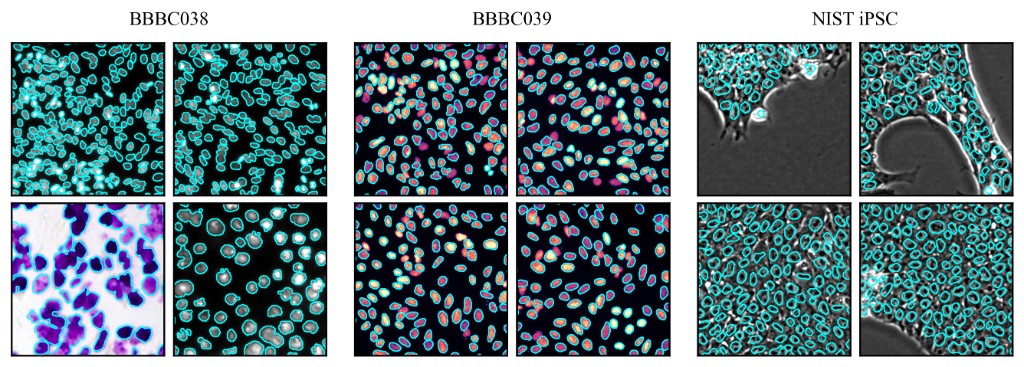
The panel covers the modality mix labs actually encounter — heterogeneous nuclei, fluorescence, and iPSC phase contrast from sparse plating through confluence — so a passing verdict means something operational.
Why this matters for Capicú deployments
This work is how we qualify compressed vision models for instrument-adjacent use: smaller footprints, lower compute, and an explicit pass/fail story per modality. It is the same philosophy behind our open Cellpose-SAM WQuant releases and Benchmarking Is Not Verification — intelligence only becomes useful at the point of sensing when compression is audited for the regimes you run, not just the leaderboard you prefer.
If you are evaluating foundation models for stem-cell imaging, QC microscopy, or edge biological instrumentation, this is the bar we use: fix the margin, stratify the panel, and ship only what retains.